Bernstein Feinkost: Pre-ordering with a live link to the opera house.
Opera guests order their food online in advance, after selecting the specific performance. We automatically imported the complete event feed of the Deutsche Oper am Rhein into the web shop. This includes detecting whether a performance has one, two, or no intermissions at all. Three brands, three websites, one central ordering system.
Starting point
Three brands. One recurring problem.
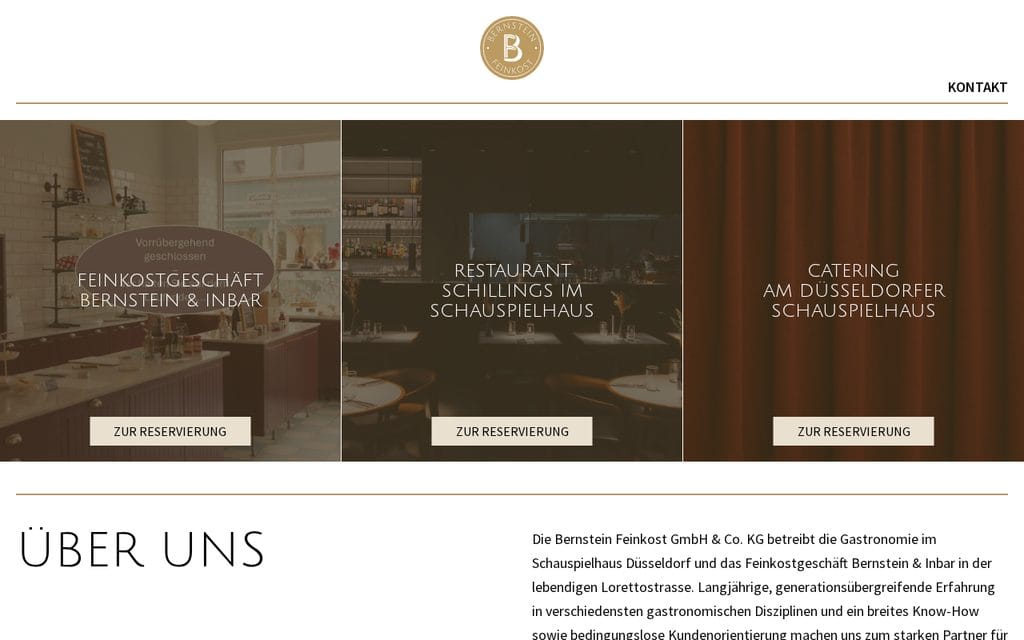
With Bernstein Feinkost GmbH & Co. KG in Aachen, André Schillings runs an established delicatessen business with several pillars: Bernstein Feinkost as the brand itself, Bernstein & Inbar as a second line and, the most exciting area at the time, the catering operation of the Deutsche Oper am Rhein. Three brands, three websites, technically completely independent of one another.
The recurring problem: opera guests are on site within a narrow window between the performance and the intermission. Anyone who first has to choose, order, and pay during the twenty-minute intermission has no time left to eat. The solution had to be pre-ordering, but one that matches the booked performance exactly, with the correct number of intermissions assigned and with service at the right time at the right table in the foyer.
What we did
One platform, three websites, five ordering phases
The request came from André himself: a layout concept already existed, and we brought it to life technically and extended it with logic that was not foreseen in the original draft. Innovations like these are our contribution to every project: we don’t just build what is already defined, but think along at every step about whether something can be technically simplified or extended.
- Three independent WordPress themes for bernstein-feinkost.de, bernstein-inbar.de and schillings-im-schauspielhaus.de, each with its own brand identity but a shared technical foundation.
- Interface to the event data export. The feed of the Deutsche Oper am Rhein is read out via a cron job, and all performances are automatically created as events, including date, time, event image, and intermission information from the original text.
- Custom intermission detection system. Some pieces have no intermission, some one, some two. We developed a parser that automatically detects from the opera’s event text how many intermissions each performance has, so that the guest only ever sees the order times that are actually available.
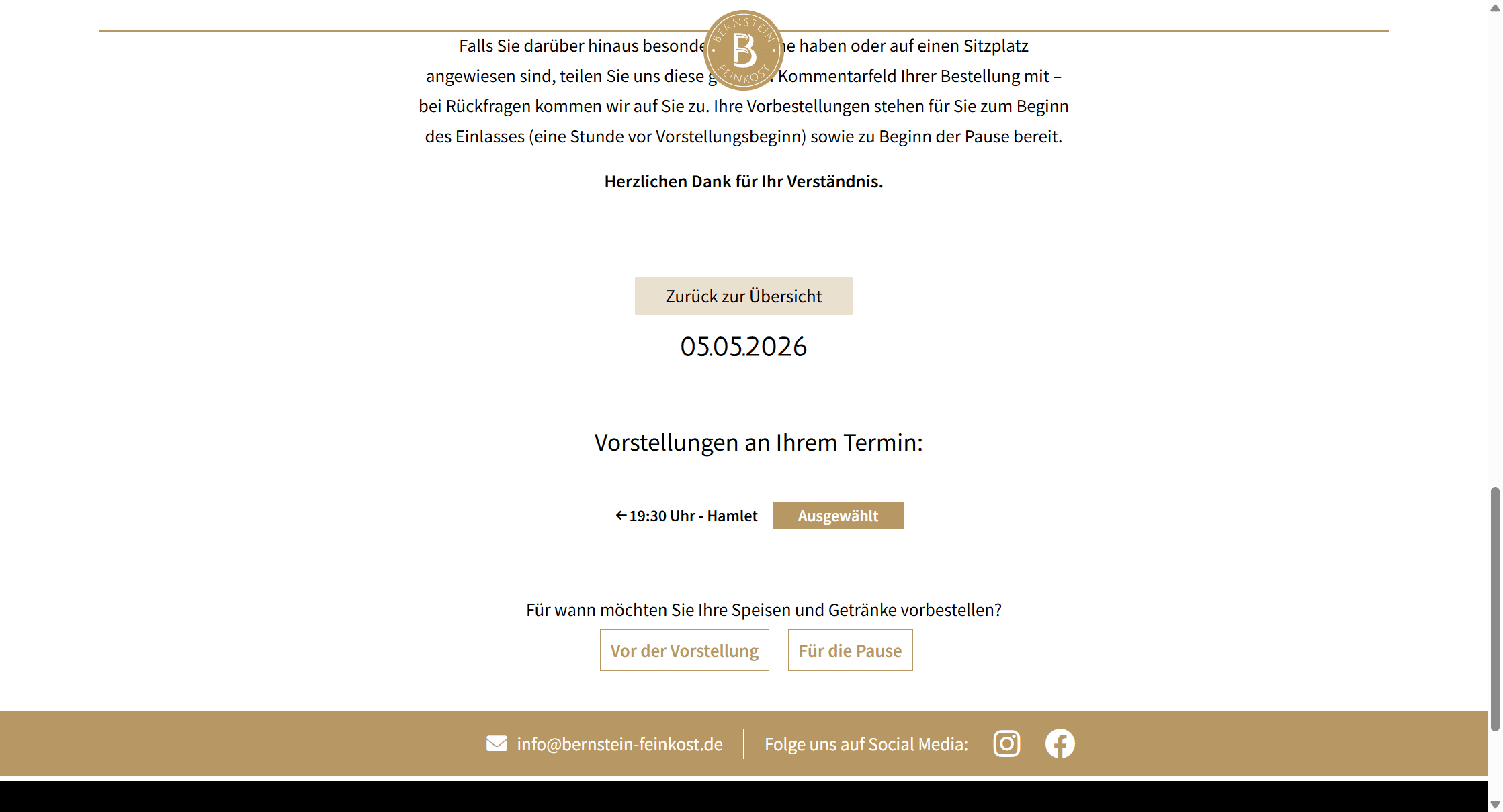
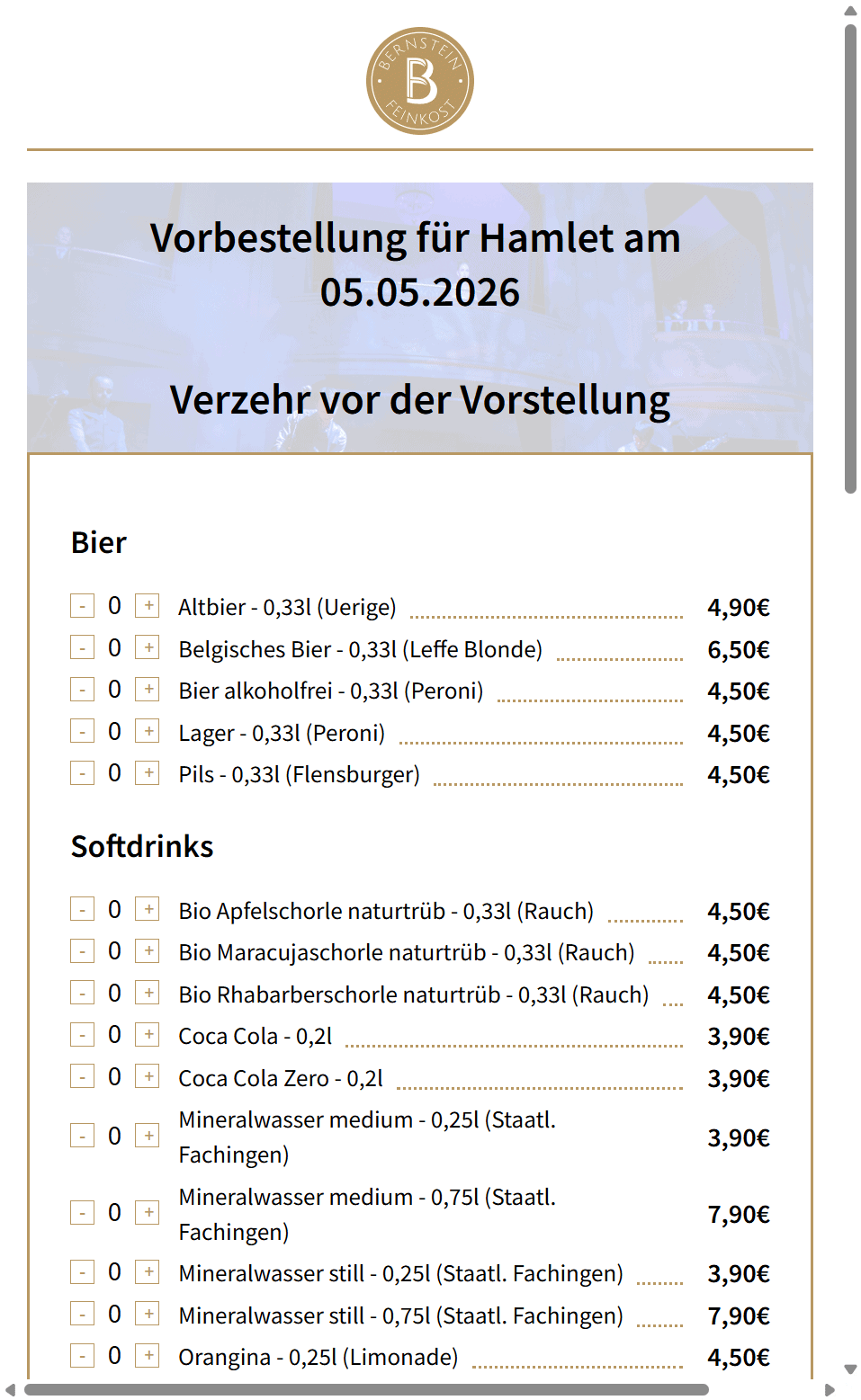
- Pre-ordering in five phases. For each performance, the guest can order separately for each point in time: before the performance, during intermission 1, during intermission 2, after the performance. For each order, it is recorded which table in the foyer is reserved.
- Daily order overview for the service team. An automatic cron job sends out a consolidated overview of all of the day’s orders every midday, to management, service, kitchen, and external distribution lists. This way the team knows before the start of the shift what needs to be ready at what time for which guest.
- Cut-off logic: from 12:00 noon on the day of the performance, online orders are automatically deactivated, with a clear notice to guests that from then on orders can only be placed with staff on site.
The five ordering phases
Individual per performance, depending on the number of intermissions
Depending on the performance, the guest only sees the phases that are actually available for their piece. A performance with no intermission only shows “before” and “after”. A performance with two intermissions shows five options:
A typical learning moment
When tables suddenly ran short
In April 2023, a few weeks after going live, André got in touch one evening: “All tables booked out on site and someone just bought online for this evening too.” The response was stronger than we had planned for. On site and online had booked the same table in parallel, a conflict that only shows up once a system is genuinely being used.
The solution came the very same night: we built in a table contingent logic that dynamically limits the online order limit per performance, so that as soon as the seats for a performance run short, online pre-ordering is automatically closed. On-site staff and the online system have worked together cleanly ever since.
“You only see problems like this once a system is genuinely being used. We hadn’t planned for the double booking in the first concept, because nobody expected that on-site and online would overwrite each other. The solution was not a matter of days, but of hours.”
Talha Sariyürek· Managing Director, KonzeptCode
Result
Over two years. Over a thousand order days.
Live since April 2023. Over the runtime, almost 1,000 performances were automatically imported from the event feed, with most pieces running over several days, weeks, or entire seasons. One order overview email to the team, to service, and to the external distribution lists per day: more than a thousand of these emails have been sent since launch.
Today the platform also supports Schillings im Schauspielhaus Düsseldorf: the same logic, the same system, another event partner. That is exactly the point of well-built architecture: it grows with the business without the technology having to be set up again.
We still support the platform to this day. Updates, security, support, new features, all from a single source, with the same point of contact since 2021.
Trust over the years
In ongoing collaboration since March 2021. Three brands, one point of contact, without a change.
While business partners, locations, and even stages have changed over the years, the technical support has stayed constant. Proof that a solo agency can deliver reliability at enterprise level.

In working with KC we greatly value the pragmatism and the reliability!